
Product overview
Technical descriptions
The descriptions and static frames below explain the illustrated arrangements, including alternative views and selectable scenarios. Screenshots show the website examples; their accompanying text identifies what each example represents.
In these operational descriptions, visual observations mean information derived by applying machine learning to visual information: images, video frames, depth images, point clouds or inspection imagery. Models can detect and segment people and objects, estimate pose and placement, track movement, recognise actions, retrieve appearance candidates and identify anomalies. Sensor fusion associates selected visual outputs with other sensor measurements and operational records. Decorative drawings and website simulations remain illustrations rather than model outputs. Sensor-fusion methods and technology catalogue.
Connected sensor field
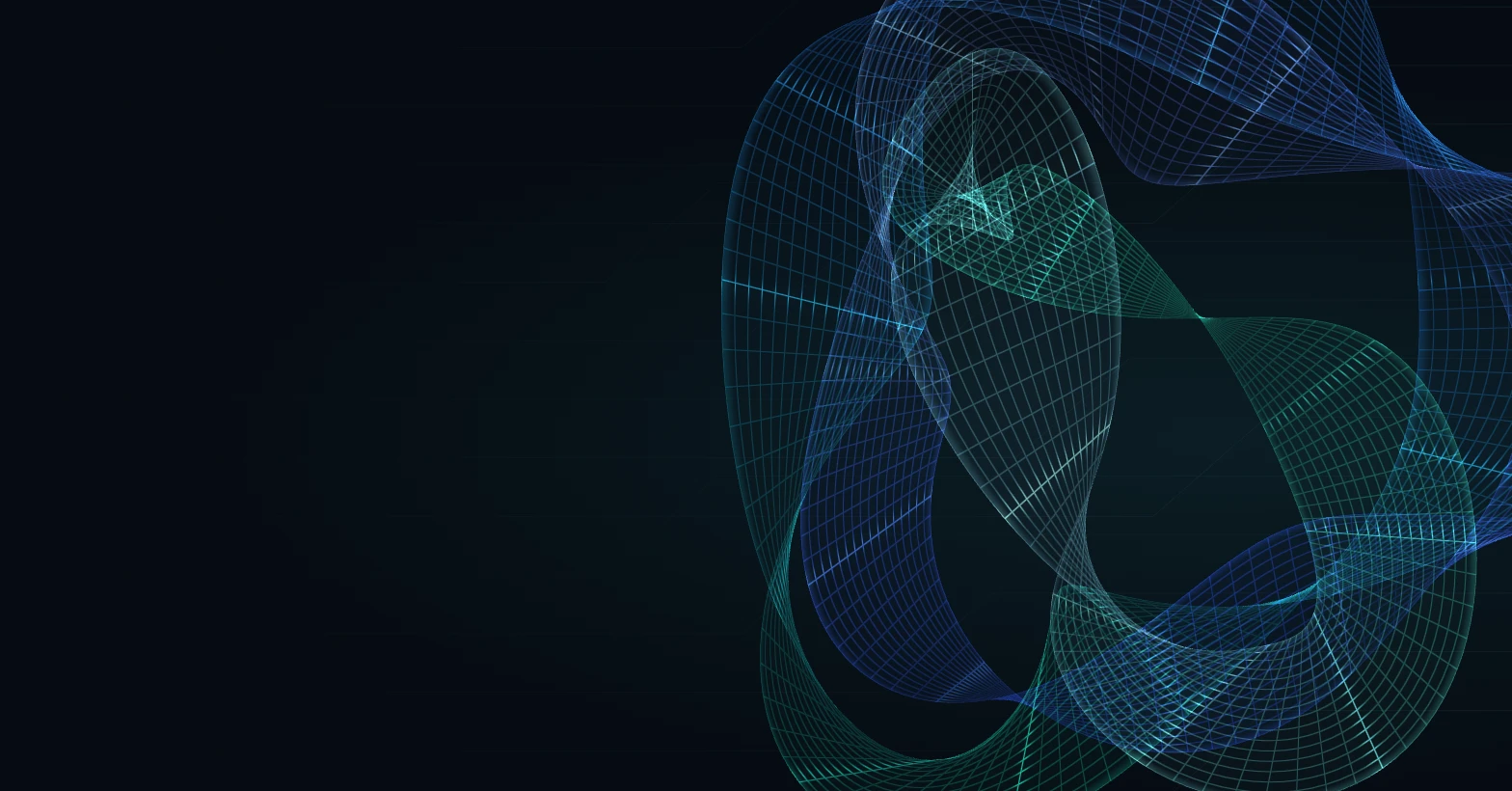
An animated spatial field introduces the combination of observations from different sources.
View the product example · Permanent figure link
The field draws a schematic environment, moving observations and connections between observations. Their positions and motion communicate the idea of following activity in a shared spatial representation rather than viewing each source independently.
The animated geometry introduces the connected operational picture. The individual product descriptions below explain the arrangements represented by the overview.
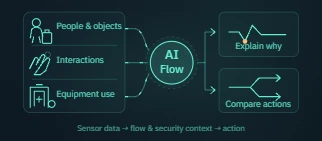
SensorSync product illustration
Observations connect through an analysis stage to operational outputs.
View the product example · Permanent figure link
The left side represents people and objects, interactions and equipment usage. Lines connect these observations to a central SensorSync AI and Flow stage; the outgoing connections represent information used to understand operations and choose a response.
The moving signals illustrate information flow. They do not specify a network protocol or processing delay. The compact navigation symbol uses the central part of the same drawing as a static vector illustration.
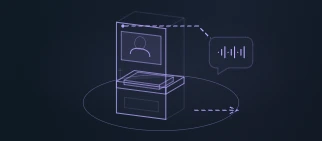
AIVA product illustration
A kiosk combines observation, passenger guidance and a connection to the lane.
View the product example · Permanent figure link
The schematic shows a passenger-facing AIVA module, a preparation area, a tray and a speech interaction. Observation and guidance are represented together so that preparation can be checked and the passenger can receive a relevant instruction.
The visual introduces the divest and passenger-assistance functions. Detailed examples describe tray loading, preparation guidance, queue assistance and terminal services. Animated scan and speech marks represent observation and guidance; the menu uses a still vector version.
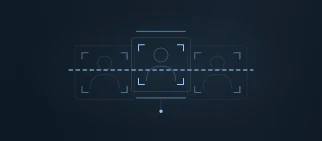
NexuSec product illustration
Candidate appearances connect a search to relevant video.
View the product example · Permanent figure link
Several camera-style frames contain person outlines. A highlighted central frame, scanning line and connecting marks represent the retrieval and review of candidate appearances from footage.
A candidate appearance is a result for operator investigation. The illustration does not establish identity. The detailed search examples distinguish a reference-image query from a separate written-description query and return the operator to source footage.
Deeper Scan product illustration
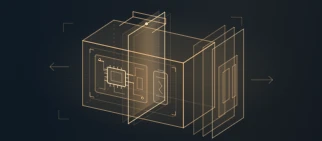
A layered inspection drawing represents viewing beneath an object surface.
View the product example · Permanent figure link
The drawing combines an inspection enclosure, internal object geometry and scan planes. Movement through the geometry represents the examination of internal structure in CT or X-ray inspection.
This is a schematic of the product family, not a captured scan or a dimensional cabinet specification. Separate technical descriptions cover browser viewing, annotation and model development, object insertion and cabinet-based device comparison.
Security illustrations
Four product illustrations describe complementary contributions to security.
View the product example · Permanent figure link
SensorSync connects sensor observations around an event. AIVA connects preparation checks with guidance. NexuSec links an appearance or event to source video. Deeper Scan shows inspection of internal structure. These are different contributions, rather than a claim that every product performs every task.
The three selectable outcomes change the explanatory text and all four drawings. Every outcome is represented here as static images and text, independently of the selection on the homepage.




Efficiency illustrations
Four product illustrations describe complementary contributions to efficiency.
View the product example · Permanent figure link
SensorSync represents coordinated movement through parallel processes. AIVA shows voice or touch guidance during preparation. NexuSec depicts a query producing footage candidates. Deeper Scan depicts browser examination of scan data and internal layers.
The three selectable outcomes change the explanatory text and all four drawings. Every outcome is represented here as static images and text, independently of the selection on the homepage.




Performance illustrations
Four product illustrations describe complementary contributions to performance.
View the product example · Permanent figure link
SensorSync distinguishes live observations from a forecast. AIVA connects a passenger question to assistance. NexuSec links an event to timing and footage. Deeper Scan connects labelling, model training and testing.
The three selectable outcomes change the explanatory text and all four drawings. Every outcome is represented here as static images and text, independently of the selection on the homepage.




Connected expertise
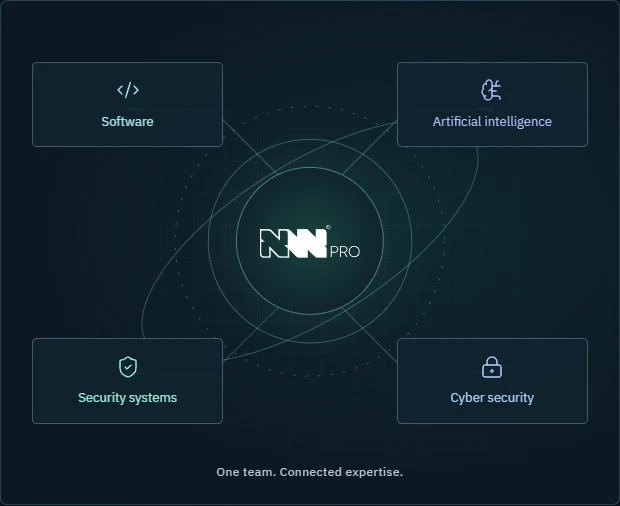
Software, AI and security expertise are brought together around a system.
View the product example · Permanent figure link
The architecture drawing places NWPRO at the centre of connected capability nodes. Animated paths and rings indicate collaboration between software, artificial intelligence, security systems and infrastructure.
The drawing is an explanation of connected delivery capabilities. It is not a physical network topology or an assertion that the displayed connections are live telemetry.
Company location map
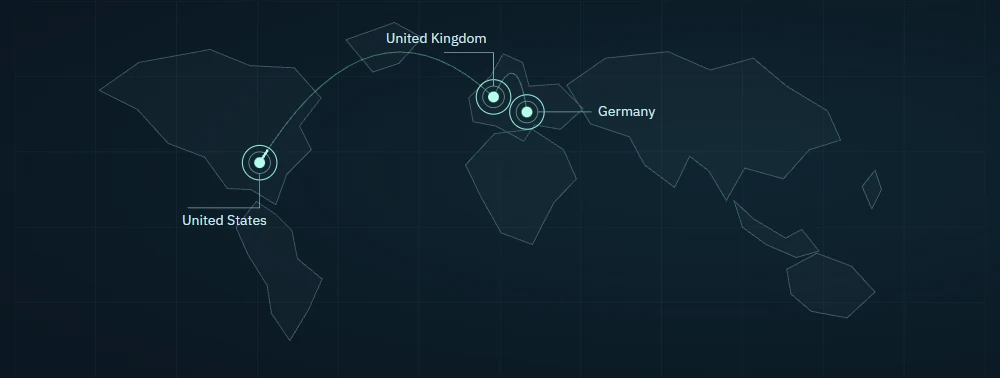
A schematic map links the United States, United Kingdom and Germany.
View the product example · Permanent figure link
The visual places labelled markers for the three company locations and joins them with curved routes. Pulses and moving packets are decorative indications of connection between the locations.
The map is geographic presentation artwork. It does not identify sensor coverage, customer sites, network routes or measured traffic.
Visual machine learning, sensor fusion and screening technologies
The following describes possible arrangements across the illustrated product families. The catalogue is broad and non-exhaustive. Sources may be used individually or in selected combinations; not every technology is integrated, demonstrated or appropriate to every product. Specialist and research techniques are identified separately from routine checkpoint equipment.
From visual information to an associated event
Acquire live or recorded visual information and selected sensor or screening outputs. Retain source identifiers, timestamps, calibration, coordinate frames, quality and available uncertainty. Processing may occur at the sensor, on an edge device, on premises, in the cloud or across these locations.
Apply trained visual models to suitable frames, image sequences, depth data, point clouds or scan volumes. Examples include object detection, instance or semantic segmentation, keypoint and pose estimation, multi-object tracking, optical flow, activity recognition, visual-language models, image or text embeddings, appearance retrieval, OCR and anomaly detection. Models and training data are selected for the modality and task; an ordinary camera does not inspect concealed contents.
Align sources in time and, where applicable, transform them into a shared spatial representation. Associate observations using time, position, motion, identifiers, appearance and task context. Fusion may combine raw measurements, extracted features, tracks, model scores, decisions or workflow events, using rules, statistical estimation, probabilistic or Bayesian methods, state estimation, learned multimodal models or combinations.
For a lane example, visual machine learning identifies a passenger loading a tray and records subsequent interactions. Spatial measurements help follow the passenger and tray; RFID or a visible code can supply a tray identifier. Screening equipment contributes scan, alarm and completion records. Association connects these to the relevant passenger, tray, article and required task, retaining links to source video and images for the interaction flipbook.
A configured workflow can request correction, a recheck or staff review, and can communicate permitted hold or release requests. Missing, conflicting, delayed or low-quality evidence remains unresolved rather than being treated as verified completion. A visual action or equipment passage alone does not establish a successful screening result. Permissions, recipient verification, equipment interfaces and approved site procedures govern any handover or control.
Visual information and optical sensing
- Visible-light colour or monochrome images; CCTV, fixed, PTZ, panoramic, fisheye, line-scan, area-scan and high-speed cameras; still images and recorded or live video.
- Low-light and near-infrared imaging; short-, mid- and long-wave infrared imaging; thermal imaging and thermography; ultraviolet imaging; polarisation imaging; multispectral and hyperspectral images.
- Stereo and multi-view imaging; RGB-D cameras; structured light; time-of-flight depth cameras; event cameras; 3D surface images, photogrammetry and laser profilometry.
- Visual text and codes, including OCR, number-plate recognition, barcodes, QR codes and other machine-readable fiducials; image-derived object, interaction, placement and appearance features.
Range, position and movement
- Scanning, solid-state or flash LiDAR; laser rangefinders; 2D or 3D point clouds and range images.
- Radar, including Doppler, FMCW, ultra-wideband and millimetre-wave radar; ultrasonic range, proximity and occupancy sensors; active infrared distance sensors and light curtains.
- Ultra-wideband positioning, Bluetooth/BLE beacons and angle measurements, Wi-Fi positioning or channel-state sensing, GNSS/GPS and other satellite positioning, inertial measurement units, accelerometers, gyroscopes, magnetometers, odometry and encoders.
- Selected passive RF receivers, spectrum monitoring, radio direction finding and RF localisation can provide transmitter or device observations; these observations require separate association with a person, vehicle or incident.
Identifiers, access and custody context
- Passive or active RFID, including LF, HF, UHF and NFC arrangements; tag readers, transponders and supported real-time location tags.
- Tray, baggage, parcel, article, passenger-session and vehicle identifiers; boarding-pass or credential readers; access-control transactions, gate state, authorised work windows and escort records.
- Where selected and permitted, biometric matching outputs such as face, fingerprint, iris or palm/vein verification. Appearance similarity and tracking are distinct from verified personal identity.
- Linked interaction, custody, routing, storage, collection, delivery and recipient-verification records, including records from external logistics systems.
Contact, load and equipment sensing
- Load cells, scales, pressure mats, instrumented floors and seating, force or torque sensors, capacitive or inductive proximity sensors, contact switches and magnetic door contacts.
- Photoelectric break beams, passive infrared motion sensors, microwave occupancy sensors, conveyor encoders, motor current, belt speed, vibration, gate position and equipment interlocks.
- PLC, SCADA and building-management signals; equipment APIs, alarms, health, maintenance, availability and processing-state records; connected screening and staff-confirmation records.
Acoustic, fibre and perimeter sensing
- Microphones and acoustic arrays; ultrasonic or other acoustic measurements; vibration sensors, accelerometers, geophones and seismic ground sensors.
- Distributed acoustic, vibration, strain or temperature sensing on optical fibre; fibre Bragg grating sensors; fence-mounted vibration or microphonic cables; taut-wire and contact-based barriers.
- Buried pressure, seismic, magnetic or radio-frequency disturbance sensors; leaky-coaxial cable, electric-field and capacitance sensors; microwave barriers; active infrared beams and laser barriers.
- Environmental context such as temperature, humidity, light, precipitation, wind, air quality, smoke, particulates and gas measurements, used where relevant to activity or source quality.
Screening by X-ray and volumetric imaging
- Single-view or multi-view transmission X-ray; single-, dual- or multi-energy imaging; backscatter imaging; computed tomography (CT), cone-beam CT and other supported volumetric reconstructions.
- Spectral or photon-counting X-ray imaging; X-ray diffraction and coherent-scatter material analysis in specialist configurations; radiographic and CT inspection of baggage, parcels, cargo, vehicles, devices or components.
- Explosive detection systems (EDS), explosive detection systems for cabin baggage (EDSCB) and automated prohibited items detection systems (APIDS): equipment or software categories whose outputs may include images, detections, alarms, review decisions and task status.
- Machine learning on suitable X-ray images or CT volumes can locate and segment objects, classify supported categories, compare expected structure and flag candidates for review. Scan viewing, annotation and synthetic object insertion can also support model training and evaluation.
People, metal and concealed-item screening
- Walk-through, handheld and other metal detection equipment; electromagnetic induction and magnetometer-based detection; shoe metal detection and shoe screening arrangements.
- Active or passive millimetre-wave imaging and other selected body or concealed-item scanners; automatic anomaly or prohibited-item detection software; specialist terahertz imaging or spectroscopy where technically suitable.
- Ionising-radiation body imaging is a separate specialised modality, usable only where specifically authorised and appropriate. Listing it here does not propose adding it to an ordinary camera or AIVA portal.
Trace, vapour, liquid and chemical screening
- Explosive trace detection (ETD), including collected particles or swabs; explosive vapour detection (EVD); liquid explosive detection systems (LEDS), bottle and container screening; shoe explosive detection.
- Ion mobility spectrometry, differential mobility spectrometry, mass spectrometry and gas chromatography with suitable detectors, including GC/MS; chemical sensor arrays and electronic noses.
- Liquid or container analysis using selected optical, Raman, infrared, microwave, radio-frequency, dielectric, ultrasonic or magnetic-resonance methods, depending on equipment design and sample compatibility.
- Raman, surface-enhanced Raman and spatially offset Raman spectroscopy; infrared and Fourier-transform infrared (FTIR) spectroscopy; laser absorption, fluorescence, chemiluminescence, colorimetric and electrochemical sensing where appropriate to the substance and sample.
- Specialist or research arrangements can include terahertz spectroscopy, photoacoustic or photothermal analysis, nuclear quadrupole resonance and neutron-based material analysis. These require purpose-built equipment and task-specific validation.
Radiological and nuclear-material screening
- Passive gamma-ray and neutron detection; radiation portal monitors, personal radiation detectors, handheld survey instruments and radiation isotope identification devices.
- Scintillation or semiconductor spectroscopy and other appropriate detector technologies; source, energy-spectrum, alarm, location and review records supplied by the screening instrument.
Other specialist screening and detection inputs
- Chemical and biological monitoring can supply gas, vapour, aerosol or particle measurements, fluorescence or optical-scattering signals, immunoassay results, molecular-assay results or other instrument records. Sampling, laboratory confirmation and handling requirements depend on the target and method.
- Cargo or vehicle occupancy checks can contribute carbon-dioxide measurements, acoustic or vibration observations, heartbeat or motion sensing, thermal imagery and inspection results. These are candidate observations rather than automatic confirmation that a person is present.
- Document examination can contribute visible, ultraviolet or infrared images, optical security-feature checks, chip or credential validation and staff findings; these records can be associated with a session under the selected procedures.
Device, component and material inspection
- Visual or optical inspection, microscopy, borescopes, 3D surface measurement, industrial X-ray or gamma radiography, industrial CT and specialist neutron imaging.
- Ultrasonic testing, phased-array or time-of-flight ultrasonic techniques, acoustic emission, eddy-current and other electromagnetic testing, magnetic-particle inspection and liquid-penetrant testing.
- Thermography, shearography, strain or vibration analysis, electrical continuity, resistance, capacitance or impedance measurements and functional device tests, where appropriate to the inspection.
- Reference-image or reference-volume comparison, component recognition, missing or additional part detection, configuration comparison and anomaly analysis. These industrial inspection methods are distinct from routine passenger screening.
Operational records and human screening
- Search, pat-down, secondary inspection, canine screening, document examination, alarm resolution and staff-confirmed completion records. These contribute workflow evidence without being relabelled as electronic sensors.
- Queue, staffing, flight or transport schedules, resource availability, accessibility requirements, passenger instructions, authorised permissions and incident records can provide context for fusion, validation, forecasting and response.
- Any selected combination may use instrument-native analysis, separate machine-learning models, human review or a combination. Availability, compatibility and required approvals are determined for the actual equipment and installation.
Background references
These public references explain selected technology families. They do not certify NWPRO products or establish that any listed integration has been implemented.
- NIST: sensing and perception. Camera calibration and 3D sensing.
- NIST: quantitative information from images. Spatial, spectral, temporal and polarisation information.
- NIST: audiovisual sensor fusion. An example of combining information from different modalities.
- NPSA: perimeter intrusion detection. Perimeter sensor families and site context.
- ECAC: security equipment categories. Screening equipment categories; evaluation applies to specific configurations.
- DHS: baggage, cargo and people screening. Screening research and development.
- DHS: explosives trace detectors. Trace detection and ion mobility spectrometry.
- DHS: chemical analysis technologies. IMS, Raman and FTIR analysis.
- DHS: portable GC/MS. Field chemical analysis.
- NIST: microwave liquid analysis. An example of non-optical liquid identification.
- NIST: biological detection equipment. Biological detection and identification methods.
- GAO: air-cargo screening methods. Historical discussion of cargo screening and occupancy checks, not a current equipment approval list.
- IAEA: industrial non-destructive testing. Optical, radiographic, ultrasonic, electromagnetic and other NDT methods.
- PNNL: infrared and terahertz research. Specialist spectroscopic measurements.
- Nuclear quadrupole resonance research. An experimental material-detection approach.
- DHS: radiological detection instruments. Portal monitors, isotope identification and personal detectors.